UBS is making the most of a one-month EMERGE exchange scheme to strengthen its scientific collaboration with the University of Limerick
UBS is making the most of a one-month EMERGE exchange scheme to strengthen its scientific collaboration with the University of LimerickThanks to the ‘Third-places Fellowships’ programme run by the European EMERGE alliance, Yann Guevel, a research engineer at the Dupuy de Lôme Research Institute (IRDL) at Université Bretagne Sud, undertook a one-month scientific exchange scheme at the Bernal Institute at the University of Limerick in Ireland.
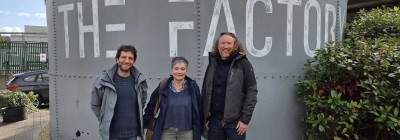
This visit, which took place from 14 September to 16 October 2026, aimed to strengthen an emerging collaboration focusing on the mechanics of composite structures and advanced numerical methods. The visit not only confirmed several avenues of research but also laid the foundations for high-potential scientific projects.
A collaboration built on complementary areas of expertise
The origins of this exchange date back to an initial Erasmus+ placement in 2025 (link to last year’s article) at the University of Limerick. During that visit, Yann Guevel identified numerous areas of scientific common ground with researchers Vincenzo Oliveri and Giovanni Zucco, recognised specialists in the mechanics of composite structures.

The research focuses more specifically on the study of instability phenomena in lightweight structures. Long regarded as risks that could lead to material failure, these instabilities are now being explored as genuine functional features that enable the design of structures that are more efficient, lighter and more energy-efficient.
A successful proof of concept
The main objective of the visit was to integrate an analytical method developed at the IRDL into the digital tool designed by Vincenzo Oliveri at the Bernal Institute.
Over the course of the five-week working period, the researchers succeeded in implementing several key methodological components. The initial numerical results demonstrated the feasibility of this approach and validated an initial proof of concept.
‘Obtaining the first sets of results was a particularly significant moment during the visit,’ emphasises Yann Guevel in his report.

A second major breakthrough was achieved with the implementation of an innovative tool for detecting bifurcations, a phenomenon that is crucial in the study of structures with multiple equilibrium states. This contribution could eventually lead to scientific publications and international presentations.
New research opportunities
Beyond the initial project, this exchange has opened up new perspectives for collaboration.
Discussions with Christelle Combescure, a researcher at the IRDL, have revealed unexpected areas of common ground relating to metamaterials. This convergence has already led to the drafting of an internship proposal and paves the way for a joint research programme.
Further discussions with Grégory Girault have also made it possible to envisage experimental validation through laser vibrometry measurement campaigns.
At the same time, a new research project has been identified with Giovanni Zucco. Currently in the feasibility study phase, it could, in the medium term, involve interns, PhD students or postdoctoral researchers.
Towards partnerships with industry
The prospects extend well beyond the academic sphere. Several companies in the aerospace sector have already expressed an interest in the research being carried out between Lorient and Limerick.
The teams are now exploring various sources of funding and are keeping a close eye on future European calls for proposals, particularly within the framework of the EMERGE alliance.
The aim is to secure the human and financial resources needed to transform these initial advances into sustainable research programmes.
A highly positive scientific outcome
Whilst certain organisational difficulties have at times limited meetings with other teams at the Bernal Institute, the scientific outcome of this exchange is considered particularly satisfactory.
In the space of a month, the researchers have succeeded in turning discussions begun a year earlier into concrete achievements. A long-term international collaboration is now underway between the IRDL and the University of Limerick, with the hope of producing scientific publications and new European research projects in the near future.
This exchange fully illustrates the ambition of the EMERGE alliance: to foster encounters between European researchers and to foster collaborations capable of addressing the scientific and industrial challenges of tomorrow.
- Faculty of Law and Political Science
Faculty of Law and Political ScienceCampus Vannes · 02 97 01 26 00 - Faculty of Arts, Humanities and Social Sciences
Faculty of Arts, Humanities and Social SciencesCampus Lorient · 02 97 87 29 29 - Faculty of Sciences and Engineering Sciences
Faculty of Sciences and Engineering SciencesCampus Lorient · 02 97 88 05 50
Campus Vannes · 02 97 01 70 70 - School of Engineering
School of EngineeringCampus Lorient · 02 97 88 05 59
Campus Vannes · 02 97 01 72 73 - Lorient and Pontivy Institute of Technology
Lorient and Pontivy Institute of TechnologyCampus Lorient · 02 97 87 28 00
Campus Pontivy · 02 97 27 67 70 - Vannes Institute of Technology
Vannes Institute of TechnologyCampus Vannes-Kercado · 02 97 62 64 64 - IAE Bretagne Sud
IAE Bretagne SudCampus Vannes · 02 97 01 26 05
 Lorient Campus27 rue Armand Guillemot
CS 7030, 56321 LORIENT Cedex Pontivy CampusAllée des Pommiers
56300 Pontivy Vannes CampusRue André Lwoff
CS 60573, 56017 VANNES Cedex